A nice little video encapsulating Blue Is The Warmest Color, such a beautifully emotional film, along with the best song in the film, Lykke Li’s “I Follow Rivers.”
A nice little video encapsulating Blue Is The Warmest Color, such a beautifully emotional film, along with the best song in the film, Lykke Li’s “I Follow Rivers.”

“Foreigners belong in France because they have always been here and did what they had to do there and remained foreigners there. Of course they all came to France, a great many to paint pictures. So it begins to be reasonable that the 20th century needed the background of Paris, the place where tradition was so firm that they could let anyone have the emotion of unreality. Paris was where the 20th century was.” – Gertrude Stein
Films with shots that can stand alone as photographs demonstrate the quality of the filmmaker, and I think this is truly how you can tell that a filmmaker is great. Ida is a film with very interesting, unique shots that can definitely stand alone as photographs. It is shot in black & white, which makes it look more dramatic and authentic to begin with, not to mention the beautiful cinematography, which makes it really very compelling.

A Polish movie directed by Pawel Pawlikowski, it is about a young girl abandoned at a convent as a baby who goes on a journey to find out about her family as a young adult. She does not do so by choice, but is rather forced to meet her aunt by the Mother Superior at the convent shortly before she is to take her vows. Ida’s first encounter with her aunt is not a positive one, as her aunt does not seem very interested in meeting her, and not yet knowing what her profession is, comes off as a prostitute. Ida is about to go back to the convent after their brief meeting when her aunt retrieves her and decides to start a relationship with her. Ida finds out that she comes from a Jewish family, and considering she is preparing to take her vows to become a Catholic nun shortly thereafter is rather ironic.


Ida and her aunt go on a little road trip to find out what happened to her parents and they meet the family that was hiding them. This family turns out to be rather unpleasant, although helpful in the end. They find out that her parents and a young boy, who appears to be either Ida’s brother or her aunt’s son, are buried in the woods. He takes them there and digs out the grave so that Ida and her aunt can have proof and perhaps gain some closure. The aunt takes the child’s skull in her arms and Ida does the same with her parents so they can give them a proper burial at the family gravesite. I must admit this sequence is eerie, but it does bring a sense of closure both to Ida and her aunt and to the audience.


Along the way, they pick up a young musician looking for a ride. He happens to be going to the same place they are and performs shows at the hotel where Ida and her aunt are staying. Ida and the musician develop a bit of crush on each other, which in time develops into a relationship. It ends, however, after a sexual encounter much welcomed by Ida, but propels her back to the convent to take her vows and become a nun. Meanwhile, her aunt commits suicide by jumping out of her apartment window and Ida is again left without a family. This is perhaps one of the reasons she decides to go back to the convent. Her blossoming relationship with the musician is brief and filled with passion, but not true love and would not have necessarily turned out to be long-lasting even if she had stayed.

It is a slow-moving movie, it is a quiet movie, and it is a sad movie. Its plot and unique cinematography is not for everyone, but it is beautiful. I would encourage anyone interested in foreign film or great cinematography to give it a chance. It definitely makes me eager to see more of Pawel Pawlikowki’s films and more Polish films in general.

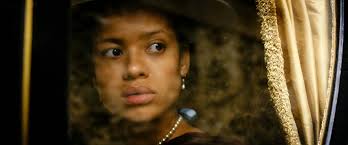
Belle is a beautiful period piece with a message and emotion. I might add that it is directed by a woman, Amma Asante, which I think attributes to why it’s so good. The opening scenes are beautiful and can stand alone as photographs (a quality I always love and look for in movies). Based on a true story, it chronicles an African-American woman’s journey from childhood to adulthood as she is taken in by an aristocratic family in England. It is not that they take her in out of pity, but rather because they are related by blood. Her father, a Royal Navy Captain and the nephew of the family who takes her in, had an affair with a woman during his travels who dies and leaves the child uncared for. Landing in good fortune and good care, she navigates her way between the wait staff and her new family, constantly trying to prove herself and deem herself worthy enough to properly belong. So not only is it a movie about social injustice and the the struggle against slavery, it is a movie about female empowerment and advancement. This is especially emphasized when the family has a portrait made of Belle and her white sister, Elizabeth, in which Belle is depicted as equal to, if not more powerful than, her sister.

The film is also about the human heart and the various suitors that are after both Belle and Elizabeth. Interestingly, when it is time for the two of them to come out as ladies in society, Elizabeth is encouraged to do so, while Belle is not because of her skin color. This drives them apart, whereas they were previously close friends and sisters. Elizabeth would be the obvious ‘preferred’ of the two because of her delicate beauty, however she is not because of her financial standing, or lack thereof. Belle, on the other hand, not encouraged to have suitors because of her ‘lesser value’ has a huge inheritance from her father who passed away at sea, which makes her desirable despite the color of her skin. She has one suitor whom she originally takes a liking to, but later realizes that he is not the one for her because his family does not respect her, as becomes evident when his brother, previously interested in Elizabeth but casts her aside when he realizes that she doesn’t have any money, assaults Belle and holds his brother in poor regard for his interest in her. All along, Belle has actually been in love with John Davinier, an aspiring lawyer who fights for the oppressed, slaves in this case. Despite resistance from her family who oppose their relationship because of his low standing, financially and professionally, they finally come around and even take his side in regard to his social and political ideals.
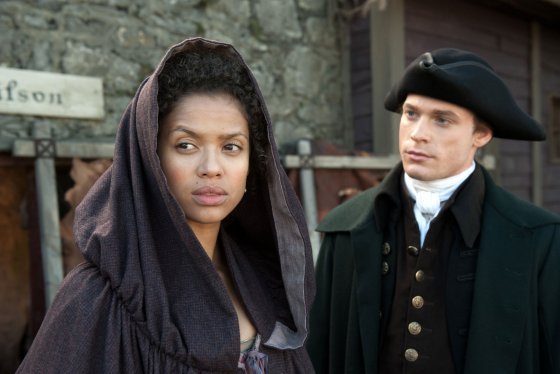
A beautifully done, captivating film that I think definitely merits a viewing. It will keep you intellectually engaged, emotionally hopeful, and visually awed.
In honor of my grandpa
Invitation to the Voyage
My child, my sister,
Think of the rapture
Of living together there!
Of loving at will,
Of loving till death,
In the land that is like you!
The misty sunlight
Of those cloudy skies
Has for my spirit the charms,
So mysterious,
Of your treacherous eyes,
Shining brightly through their tears.
There all is order and beauty,
Luxury, peace, and pleasure.
Gleaming furniture,
Polished by the years,
Will ornament our bedroom;
The rarest flowers
Mingling their fragrance
With the faint scent of amber,
The ornate ceilings,
The limpid mirrors,
The oriental splendor,
All would whisper there
Secretly to the soul
In its soft, native language.
There all is order and beauty,
Luxury, peace, and pleasure.
See on the canals
Those vessels sleeping.
Their mood is adventurous;
It’s to satisfy
Your slightest desire
That they come from the ends of the earth.
— The setting suns
Adorn the fields,
The canals, the whole city,
With hyacinth and gold;
The world falls asleep
In a warm glow of light.
There all is order and beauty,
Luxury, peace, and pleasure.

Some people just have more ‘life’ in them than others – more things they’ve done, more things they want to do, and more creative minds that take them to different places. My grandfather was such a person, and upon his recent death, my mother and I have been examining his life as we’ve been trying to write his obituary. I’m just amazed by all that he has done – not that everything he did was terribly significant, although some things certainly were, but it’s the little things like his hobbies and interests that add up to a remarkable life. He was a fantastic photographer (although not professionally trained) and set up his own darkroom in his house to develop pictures, he was an accomplished pianist (which ran in the family), he traveled extensively throughout Europe with my grandmother, he had several careers as a teacher, journalist and professor, he had an intellect that I haven’t seen surpassed by anyone else that I’ve encountered (although I’ve had some fantastic professors that have come close), and was an art collector & chess player. He fled his homeland due to political unrest and left his family behind, never to see them again, lived in four countries ranging two continents, and knew four languages. He wrote several scholarly books and articles and, most importantly, he had a tremendous sense of humor. He made fun of people, criticized everything, and had very strong opinions regarding politics; but now, looking back, it was all in good fun (maybe). As I think about all these things that my grandfather has done and accomplished, I just can’t fathom that someone could have the enthusiasm to do all those things with and the heart to survive some of the things that he has. It’s really amazing to me. Like I said, some people just have more ‘life’ in them than others.
John Dewey believes that certain extraordinary experiences can be works of art – the kinds of experiences that make us feel completely in the moment and that are really memorable. I have to agree with him because there are certain experiences that stand apart from others because there is a certain feeling of genuineness about them – things like a Sunday drive or an outing to a place you’ve never been before that you end up thoroughly enjoying even though you had no expectations.
Many of the experiences that we have on a day-to-day basis do not possess an extraordinary quality. However, some experiences seem to evolve in a way that is very satisfying to us and perhaps we learn something from the experience that helps us makes sense of our lives or enlightens us in some way, giving us direction.
Likewise, many things in life are constantly evolving, which is why it is so important for us to fully immerse ourselves in an experience so that we do not miss the evolution of the experience. Dewey argues that it is when we are fully immersed in an experience that we are living most artfully. If one focuses on an experience and becomes part of the experience and directly involved with it, rather than standing outside the experience looking in on it, one can have a truly magnificent experience. On the other hand, if one goes through life not paying much attention to his experiences, therefore preventing the possibility of an extraordinary experience, this would be an indifferent stance toward life and not recommended by Dewey, or myself. Clearly, the former attempt of truly immersing oneself in an experience in order to have a unique, extraordinary experience is the better path through life, as it is richer and more fulfilling.
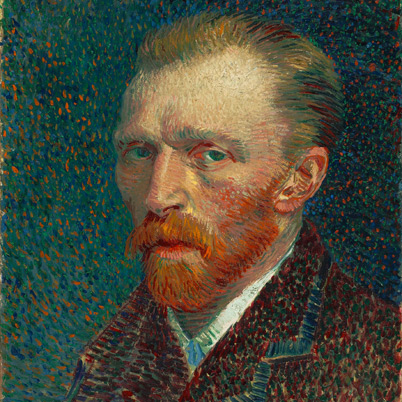
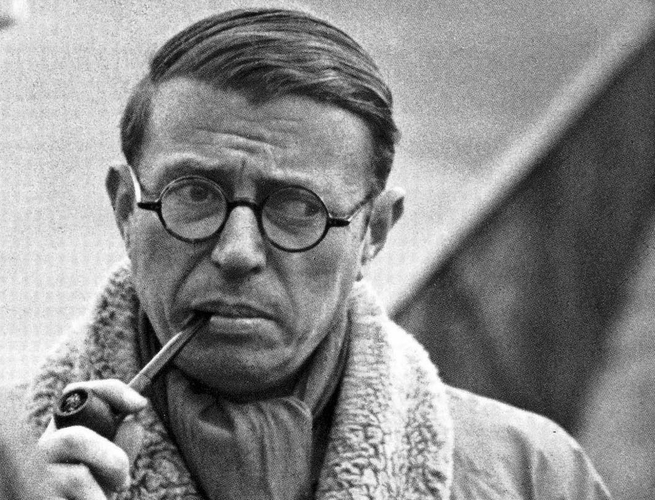

The truth is, brilliant people are usually not very pleasant. It just goes with the territory. There is a certain level of anti-socialness, rudeness, and ruthlessness that goes along with people who are very intelligent, intellectual, or gifted in a certain area. Their talent seems to give them a bit of an excuse to be unpleasant, however frustrating it is for those around them. Examples that come to mind are authors, artists, and world changers such as Jean Paul Sartre, Vincent Van Gogh, and Martin Luther King. Should their brilliance give them an excuse to be unpleasant? My immediate answer is no, but then I wonder if it’s something that they can help or not. Maybe because they are so brilliant they just can’t help but be unpleasant because the world disgusts them so much. It’s like they are too good for the world. So how do we appreciate them for their skills and accomplishments despite their unpleasantness? It’s not easy and requires a tremendous amount of patience, but if we can recognize their passion and rare talent, we can begin to respect and appreciate them.
“Moral: To sustain ardor, one must be in love not only with the thing itself, but also with the idea of the thing itself.”
I recently read this quote by Stephen Dankner in a newspaper article in The Advocate, which is based in New England, and I read it at just the perfect moment as I am trying to decide what I want to do with my future; more precisely, what I want to pursue graduate studies in and this quote sums it all up. So what do I love in essence and in thought? At the moment I am trying to make up my mind between Art History and Film. Submitting applications for both is a bit confusing and it’s hard to imagine which I would enjoy more. But reading this quote brought up a very basic, fundamental notion that I hadn’t thought of but makes all the sense in the world. Do most people have the luxury of loving what they do as well as the idea of it? Probably not. I think it’s a hard to achieve because it’s hard to even figure out what you love in essence AND in thought.

Check out my boyfriend’s new Art Blog! – http://jacobshrinerart.blogspot.com
Artist Statement
“My art is primarily concerned with themes of melancholy as an existential state resulting from a deep personal awareness of the mutability of life and the inexorable cycle of creation and destruction. Employing the human figure as the agent of expression, I paint not to emulate the appearance of reality, but rather to communicate my aesthetic emotional response to the physical and intellectual condition of being alive.” – Jacob Shriner
 gooollysandra