The life of a philosopher is a life of luxury…to just be able to sit around and think. The possibilities of thought and what one might gain insight to through thought are phenomenal. All the questions that could be answered by one very simple, fundamental thing that we take for granted, THOUGHT, are endless. And that is the beauty of thought – it is never finished, done. You can always think and think and think more…and perhaps come to more and more conclusions about things that you always wanted answers to. And those answers certainly don’t need to be final. In fact, they probably won’t be final, because as you accumulate more thoughts over time, you will probably change your mind about things and reach a different conclusion. This is the kind of life a philosopher has the luxury of leading…thinking all of the time. But after some time, the luxury may begin to fade and turn into despair as one realizes all that there is to think about and the limits of time and possible answers. Furthermore, after all is thought, what does it amount to? Does it lead to any kind of change or progress in one’s life or in the world? Perhaps sometimes yes and sometimes no. This is the despair of the life of a philosopher.
Near, far
0Things look different up close than they do from far away. Of course, this is no new sentiment. However, I have particularly noticed this lately as I look at my dog often, because he is so cute (of course), but it has struck me as something relevant to so many aspects of our lives. With my dog, he looks so noble and regal from afar, but as you get close, he’s certainly still cute, but the close proximity reveals a sweeter, fluffier side. Or with one’s significant other, for example, perhaps at first glance or when you first meet, you see them in one light, and then as you get to know them with time, you see them in a different light (not necessarily in a bad way, just different). With food, something may look and smell delicious from afar, but as you taste it, you may not like the taste and your initial positive perception of it changes. With an artwork, it may look like one thing from afar and then something else up close. I think this especially is probably a very common occurrence. Or with things like movies or music, you may have one perception of them at first glance and another as you delve further. This observation, of things appearing one way from afar and another way up close, is a fairly obvious observation but one that I think has significant implications. If this is the case, we must be very weary of how we perceive things and not jump to a quick conclusion that that perception is the correct one. We must step back and evaluate whether or not our initial impression is accurate and wait for things to settle in before we make a judgement.
Memories
0I think one’s memories and how one thinks about the past has a lot to do with one’s present mindset. For instance, good and pleasant memories can have a positive impact on one’s current state as one reflects on those good memories, and, on the other hand, bad memories can have a negative effect. I’ve discovered this as I’ve gone through both good and bad times and reflected on both. Pleasant memories are ever so rewarding as they can instantly put you in a good mood and inspire you to have similar good times in the future. However, bad memories of sad times are so difficult to get past and can certainly leave you in a rut if you cannot get past them. Lately, I have been reflecting a lot on good memories, and not even on purpose to put me in a good mood, but they just come to me…which is another thing altogether – isn’t it interesting that sometimes certain memories just come to us for no apparent reason? But on further reflection we realize that there is something happening in our present that has subconsciously reminded us of that past memory, and then the two, past and present, become connected.
Post-college conundrum
2As a recent college graduate looking for a job, the hardest thing I find about being in this position is not looking for a job itself, but rather adjusting my mindset from a college student to a working person. In college, at least for me as a philosophy major, it was all about your ideas and how well you can process and analyze information. Not to mention, writing well too. But in the working world, it’s about your skills and what kind of set of skills you have to offer to sell to someone that needs them and can use you for them. This adjustment is what I have a hard time with because I do really miss what was wanted from you in college intellectually and not too eager to have someone use me because of my skills in the ‘real world. But I suppose only time and experience will tell which of the two very different worlds I prefer, or whether or not there is one that is simply ethically better.
Thank you, Obama, for free birth control
0I am a supporter of Obama’s new birth control legislation. I think free birth control is great, and necessary, and I’m sorry to those religious folks who have a problem with it. I don’t believe we necessarily have an overpopulation problem, but there is clearly an extreme lack of dispersal of resources among all people. Few people have an overabundance and many people don’t have enough. If this lapse cannot be fixed, which has proven to be the case so far, not because of lack of possibility, but due to lack of desire by enough people to truly make a difference. Therefore, I think we need to be proactive when it comes to curbing births, especially of unwanted babies who will not be properly taken care of once born and grow up to perpetuate problems in society. This is why I think easy and widespread access to birth control is important.
Why should people be asked to give up the pleasures in life in fear of getting pregnant? They shouldn’t. Thus, I am grateful for President Obama’s new legislation on pregnancy prevention and care.
Connecting cultures
0
For the past month I have been working with women from Egypt, Tunisia, Libya, Mongolia, and Myanmar in an international institute sponsored by the U.S. State Department on Global Women’s Leadership. It has been a very interesting experience meeting people from various cultures that I have not been exposed to before and perhaps would not have had the opportunity to encounter had I not been involved in such a program. Many of the women were involved with the revolutions that took place in their countries and hearing their stories was both heartbreaking and inspiring. It really puts your life in perspective and I cannot imagine witnessing some of the things that they have.
Throughout the institute we built our leadership skills, as well as learned about U.S. women’s history and various women’s issues such as violence against women, misrepresentation in the media, and women’s entrepreneurship.
The last week we traveled to Boston, NYC, and Washington DC, culminating in a conference at the State Department where we met even more women from around the world. It was a great way to end the institute as we shared good memories and grew even closer. What I learned throughout this institute is that the world is both big and small. The world is extremely vast and there is so much to see, perhaps even some things to discover that have yet to be discover, but it is also small in that we are all part of humankind and therefore connected. For this institute, 30 people came together from 6 countries, people who may not have interacted otherwise, and discovered worlds different from their own. This kind of experience is incredibly enriching and opens one’s mind for time to come. I am so grateful to have had such an opportunity to make connections with women from around the world, and I know we will all shape the world for the better in the future.
Art’s Intrigue
2
This past year, I took a philosophy of art class and it was extremely interesting. Deciphering what a work of art is, or even what counts as art, regardless of whether or not it is good, is rather difficult. Trying to get past the subjectivity of differing tastes in art is challenging enough, but then deciding how we go about judging art is even harder, once again because of differences in opinion. Throughout the course we explored various theories on art, both old and new, including those of Plato, Clive Bell, George Dickey, Denis Dutton, Kant, Dewey, Susan Sontag, Hume, Elaine Scarry, and others.
So what comprises art? Plato’s idea is that we begin with art, or forms more generally, and as we intellectualize the forms that we witness or experience we form a more refined concept of forms, or art at this point, and come full circle. Bell believed that art was that which possessed significant form, but what exactly significant form is, is unclear. For Dickey, a work of art has to be an artifact and it has to be made for a public audience (the public audience does not necessarily need to be a big audience, just as long as there is at least one member). This idea for what art is begins to make more sense than Bell’s; although Plato’s is still amicable. Dutton believed that a work of art must be comprised of complexity, serious content, purpose, and distance. These facets are fairly self-explanatory. Distance may be a little bit trickier to understand, and it means that experiencing a work of art takes us outside of ourselves, our lives, and distances us from ourselves. His theory further defines what art is, and I see more merit in and take it more seriously than others.
Kant is often thought of as the father of aesthetics and his theory is a bit more complicated. He further defines what Bell described as significant form, in that there is something in and of itself present in a work of art independent of our experience of it, and it may out of our mind’s grasp. For Kant, it is what jars us once in a while that is ART…what takes us by surprise, or takes us aback and makes us stop and reflect on that thing. Beauty is an important component of art for Kant, so for him art must be beautiful, whatever beautiful might mean…Dewey has yet another perception of what art is. For him, art is an experience. It is not necessarily any experience that counts as a work of art, but rather those experiences that we set apart from the rest and think of as particularly special…they are AN experience rather than just random experiences. As we go through our lives, we are constantly going back and forth between the two roles of creating the experience, or art, and viewing the experience (art). He also emphasizes our stream of consciousness as being important in the formation of our experiences. AN experience is when we feel most alive and this is why the arts are valuable…to bring people to life.
Scarry has yet another take on art, as she believes that our pursuit of art is a pursuit for truth. She also thinks that when we encounter beauty we have a drive to replicate or reflect it by making art. When we experience beauty we realize the potential for error and, therefore, want to pursue truth. She even believes that beauty can lead to justice, but it is unclear exactly how…however, beauty can also get in the way of justice because it has a kind of transcendental feeling and can remove one from the injustices of the world. She criticizes that too much interest in beauty can lead to materialism, which is obviously a negative thing. I think all of these thinkers present interesting theories for art, but Dutton is probably the one that I think is the best.
One of my favorite artists is Alphonse Mucha, the Czech Art Nouveau artist. I think the way in which he depicts women is just beautiful…so perhaps this is telling that I believe beauty, of one sort or another, in one way or another, is an important facet of art. His pieces also depict real women, which adds a personal connection to the works of art. I suppose Mucha’s works give me various feelings that these philosophers have indicated as important to art…AN experience, the pursuit of truth, complexity, serious content, distance, purpose, etc. Thus, why he is one of my favorite artists and looking at, or experiencing, his works is such a pleasure for me.
Graduation blues
0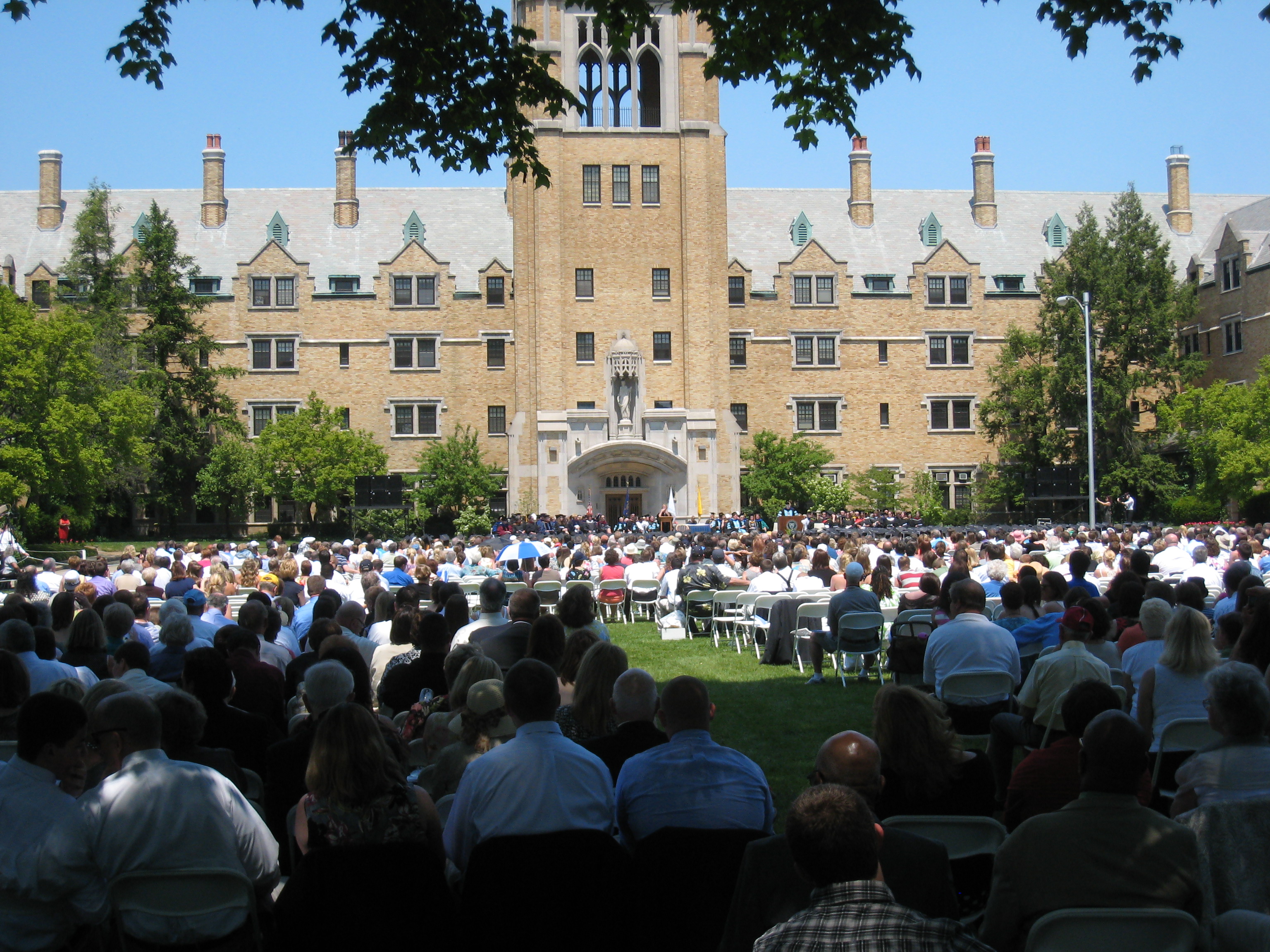
I recently graduated from college, from a small all women’s liberal arts school in Indiana – Saint Mary’s College. It is a relief to be done with all the work, but I am certainly going to miss going to classes and gaining all the wonderful knowledge that I have gained at Saint Mary’s College the past few years. I did not always like Saint Mary’s, as I transferred to another school and then transferred back, and I am so glad I did. Saint Mary’s is so much more than a school where one goes to classes and gets a degree…it really shapes the whole person and builds one’s character to be a confident woman ready to take on roles of leadership in the world. I am going to miss the intellectual stimulation that I received at Saint Mary’s everyday, and I was scared that my intellectual exercise would plummet after graduation because I find that it is harder to self-motivate myself to be productive if I do not have a due date or the guidance of a professor. However, I have tried to stay interested and informed. I finally have time to read for relaxation as opposed to reading for an assignment, which never ceased. I thought I would really really miss school with all the classes, studying, and homework, and so far I have a little bit, but not as much as I thought I would. Perhaps I just haven’t been out long enough yet and it has not entirely settled in that I am no longer a student and graduated…Either way, graduating certainly feels like an accomplishment, but I will miss college…
Private life vs. public life
0What is the difference between the lives we lead in our homes, in private, and the lives we lead in out in the public? I often wonder why it is that we are more productive in the public, at least I am, than in private. I think it is because in public, we are held accountable for our actions. We can’t just do as we please, but rather we feel the need to be productive because people are watching us. But in private, we can waste away because no one will know…This is why I always find myself going to places like Starbucks, Barnes & Noble, & local coffee shops to do work (yes, I’m one of those sorry people). But, I am not apologetic for it! I love the atmosphere of coffee shops, with people talking around me and the stirrings of coffee machines. It somehow really evokes productivity for me. Oh, and not to mention the jazz music that is typically played. And who wouldn’t be inspired in a bookstore surrounded by lots of books written by others? Never mind that most of them are probably no good, their mere presence (ignore the cover) is inspiring. So, although I should probably be working at a library, or in my home, I just don’t find those places very inspiring. Libraries are too quiet and my home is too distracting (and I can get away with doing anything but work)!
 gooollysandra